We’ve been called a lot of things, but has recovered and relentless ever been declared by us? Imagine if we didn’t just survive, but showed up ready to lead, build, and bless.
Let’s talk about what we call ourselves as Descendants of Enslaved West Africans because words matter. Accuracy matters—especially to my interpreter brain. My 9-to-5 work as a sign language and English interpreter is all about choosing language that sho’ nuff lands and hits.
We’ve been called Colored, Negro, Black, Afro- / African-American, and most recently American Descendant of Slavery (#ADOS).
Colored is absurd and a played out term from an outdated era.
Negro, the more respectable cousin of the other N-word, carries a certain dignity thanks to its ties to the Civil Rights Movement. But if it’s not getting a laugh among incognegro friends who’ve gone MIA, it’s getting side-eyed. Ya know?!
Black reflects the beautiful range of all 41 million of us in the United States. Thirty-eight million of us descend from the enslaved, while roughly 3 million are African or other Black immigrants. I ain’t mad when folks prefer to rep their roots – rocking hyphenated identities like Jamaican-American, Afro-Latino and Afro-British. But the blanket term Black blurs the lines of our distinct histories.
 Don’t trip! In the late 1980s, we hyphenated too. Afro- and African-American referred to U.S.-born Black folks who descended from enslaved West Africans. The term seemed clear-cut…until applied to “others” born in Africa, if you catch my drift. Because technically, anyone born on the African continent who becomes a U.S. citizen could claim the label African-American—yes, even Charlize Theron or Elon Musk.
When reparations talk resurfaced in 2016, the burning question became: who’s actually owed? Yvette Carnell and Antonio Moore answered by christening us American Descendants of Slavery, or ADOS. You should’ve seen me blowing up my socials, seasoning every conversation with #ADOS.
“We don’t say African-American anymore,” I’d declare, hand on hip, chest out, head high. “We’re ADOS!” My mini lecture was straight Oscar-caliber…until I got antsy about the American part.
After three summers in Europe, I realized calling myself “American” felt…arrogant. Like we in the U.S. had hijacked a term referring to an entire hemisphere…with three Americas! Canadians are Americans. So are Mexicans, Guatemalans, and Venezuelans. I jumped off that bandwagon so fast – realizing I’d been co-signing a kind of cultural monopoly without even thinking twice.
And Descendants of Slavery? Nah! We aren’t offspring of an institution, but of the individuals who endured it.
So I kept searching.
Yankee? Too loaded with white-, 13-colony, slaveholding, former British-ness.
I give Spanish their props with estadounidense, translated to something like “United Statesman” but that’s not sexy.
Then it hit me…in the fall of 2023 as I geeked out on a documentary binge. DOEWA! USA DOEWA!!!
Descendants of Enslaved West Africans.
It’s to you, the DOEWA people of the United States, that I write.
Perhaps like me you’ve felt that the names we’ve carried don’t fully hold our story. African-American. Black. Minority. So I started wondering…what if we had language that did more than just describe us? What if it honored us?
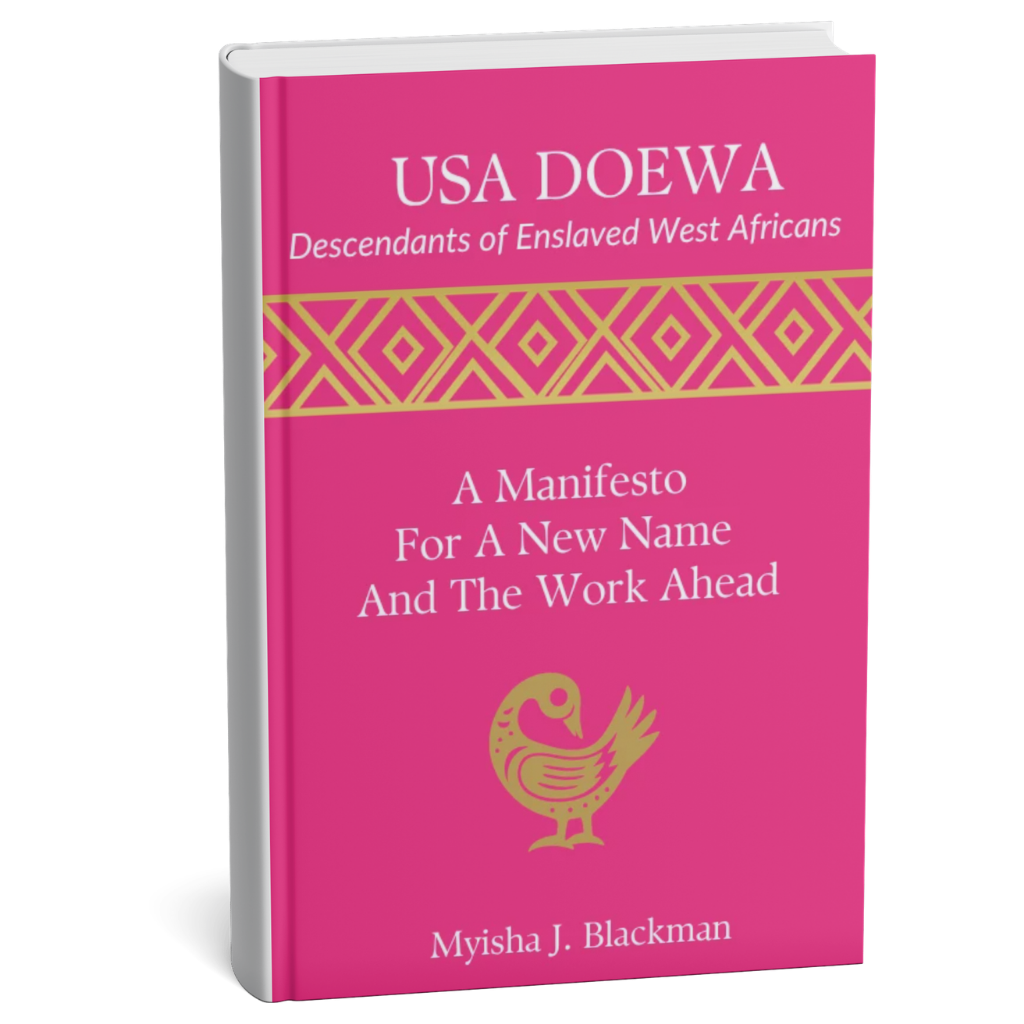
So here I am proposing a new name that we embrace. USA DOEWA: Descendants of Enslaved West Africans, born right here in the United States. Here’s a lens to see our past clearly and imagine our future boldly. With it comes a chance to unpack what this lineage really means, both the privilege and the privation. We are the living proof of a long journey from stolen names to self-definition. That’s worth sitting with to explore. And maybe, just maybe, it’s the start of something beautiful.
